
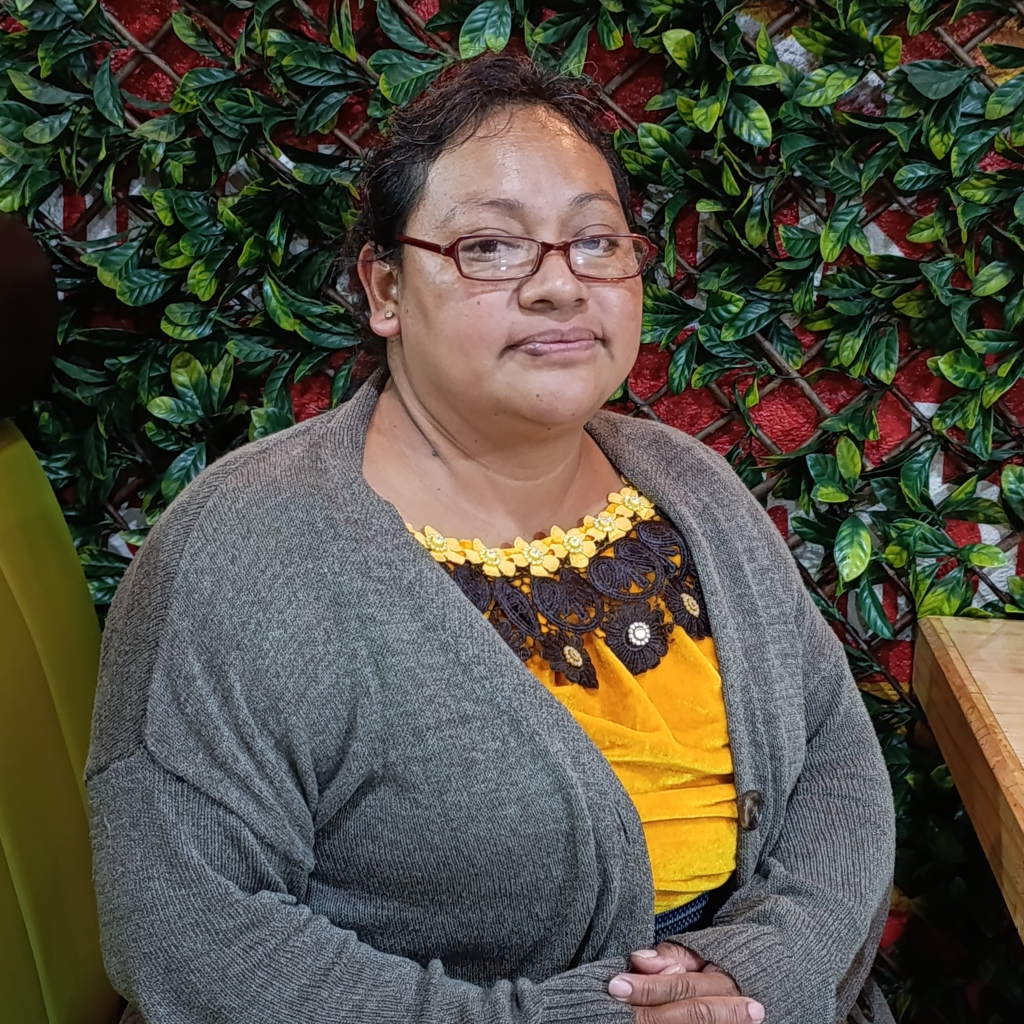
She is part of the team at the Association for the Initiative of Women’s Rights, contributing through the organization’s administrative coordination and financial area.
She leads the administrative work and provides guidance and support to participants across the different programs, especially on financial matters, which are often more complex.
Her work goes beyond administrative tasks. She makes sure that every program participant has the tools they need to work effectively, that teams function well, and that everyone feels comfortable in their work environment. Her goal is to make processes shorter and more efficient so no one has to wait too long. But Gloria is much more than her job title.
Being an Indigenous woman in Guatemala: a silent struggle
For Gloria, being an Indigenous woman in Guatemala has been a significant challenge. “Before working in civil society organizations, I experienced a great deal of ethnic discrimination, including being forced to remove my Maya clothing. At the time, it felt normal to me; I didn’t realize it was a violation of my rights until I began working with organizations and understood everything that had happened.” “Women—especially Indigenous women—have long been seen as incapable of holding senior positions within organizations. Now I know that we all have opportunities and that we can do it. We have shown that, as Indigenous women, we are achieving it.”
Gloria recalls with pain how, in one of her jobs, a colleague in a higher position constantly mocked her. After leaving that workplace, Gloria began wearing her Maya clothing again; however, her former colleague would no longer greet her and did not want her nearby. This is how racism and discrimination diminish women—especially Indigenous women.
This experience led Gloria to reflect that Indigenous women have begun the process of breaking barriers and stepping into positions of power and decision-making, but that this change is generational.
Other barriers women—and Indigenous women in particular—face in exercising leadership include machismo and gender inequality. “That’s why what we need are small pushes from other colleagues, other organizations, from people who believe in us,” she says. This is reflected in the in-person gatherings included in the leadership program, which have been incredibly helpful—moments with myself that have strengthened everything I am doing.
Looking in the mirror and recognizing onesel
Today, when Gloria looks in the mirror, she says to herself:
“Wow, look how far you’ve come.”
She sees herself as a strong woman who has learned to share that strength with others. Along her journey—both personal and professional—she has noticed deep changes, even in the way she speaks.
She now sees herself as someone capable of achieving what she sets out to do. Today, she is the Gloria who, as a child, had many dreams—and who has seen them come true in many ways. She recalls with emotion that she had her first dream at the age of eight and achieved it at twenty-five.
“I am a Gloria who has fought, moved forward, and—despite the ups and downs I’ve faced in life—has managed to overcome them.”
The transformation of her leadership
Before joining the Mujeres Liderando program, Gloria did not see her leadership clearly reflected. She felt restrained, struggled to move forward, doubted herself, and often thought:
“I’m not going to say this because it might not be the right thing, I might be wrong, I might contradict what has already been said.”
However, after participating for almost a year in the Mujeres Liderando training program, she says things are different now, as she feels empowered in her role, as she explains:
“The change has been noticeable. One of my colleagues commented on the changes she has seen in me—she told me I’ve become much more confident when advising and speaking with others. Working with so many people, each with their own personality, and managing to bring everyone along has been a difficult and complex process, but I’ve achieved that balance with all of them.”
English as a tool for empowerment
For Gloria, learning English is a very useful and important tool today. It is a language that opens access to spaces where participation is often limited because of language barriers. At the same time, it has been a challenge. After a few months of studying English, people began to say to her, “And what is that going to be useful for? To begin with, you’re a woman.” And Gloria replied:
“Yes—but a woman shouldn’t have limits when it comes to learning.”
She recognizes the importance of Maya languages, but also understands that organizations take part in conferences and other international spaces where English is necessary. Many times, not knowing the language causes women to remain silent and unable to express themselves. And when they remain silent, they allow others to make decisions for them.
“Yes, I believe this is something very valuable for us as Indigenous women—something we should aspire to and dream about. And above all, if at any point we have that opportunity, we should take advantage of it, because it helps us break silences and move toward something much better in the future.”
New aspirations
Now that Gloria is strengthening her skills and knowledge through leadership training—while holding two key roles within her organization (administration and finance) and gaining experience working as part of a team—she believes she can reach a higher position, either by advancing within her current organization or in other spaces.
“This rediscovery of my skills and potential has been shaped by many elements connected to Mujeres Liderando—different trainings, experiences, and people—which have made me feel transformed, filled with aspirations, dreams, and professional growth.”
Inspiring others
Gloria ha logrado inspirar a sus compañeras y a otras mujeres cercanas. De hecho, se lo han dicho “me gustaría poder también hacer lo mismo, me gustaría poder salir de esto”. Sin embargo, muchas se limitan a sí mismas, poniendo como pretexto el tiempo
“You can do it because you already made time, but in my case, I can’t.”
Even within her family, they have noticed a big difference. They have asked her, “What’s happened to you? What have you been doing?” The confidence Gloria has gained is the same confidence other women are searching for.
La inspiración que Gloria genera es a veces inconsciente. No va diciéndole al mundo “miren, estoy así, ahora ya cambié”, sino que sus acciones hacen que la gente se pregunte qué pasó, qué hizo, qué está haciendo?
Dreams and aspirations for Indigenous women and girls
Gloria has many aspirations, but her main one is that all women and girls have the freedom to continue their education and to live full, well-rounded lives.
“Women have always been held back in so many of the things we aspire to,” Gloria reflects. That’s why she hopes all women can have freedom—because with freedom, they can begin to dream and start seeing themselves as women leaders in the future.
A message to the world
“I want the world to know that I am capable of achieving what I set out to do. That I am now living a happiness I have felt for some time. That I have climbed very difficult steps, broken barriers, and reached where I am today. I want them to know that I can do things—that I can achieve—no matter where I am. I know I can move forward.”
Gloria has even envisioned herself in a role where she can make decisions at the national level to support women—especially Indigenous women who have been held back. “I don’t know if I’ll achieve it or not, but I will fight to get there.”
Stories like Gloria’s are made possible through training processes, ongoing support, and networks of solidarity among women.
Support, share, or learn more about our programs and be part of the transformation of Indigenous women’s leadership in Guatemala.
Because when a woman is empowered, she transforms her life—and the lives of many others..